Vishnu Sahasranama: What It Is & How to Recite It
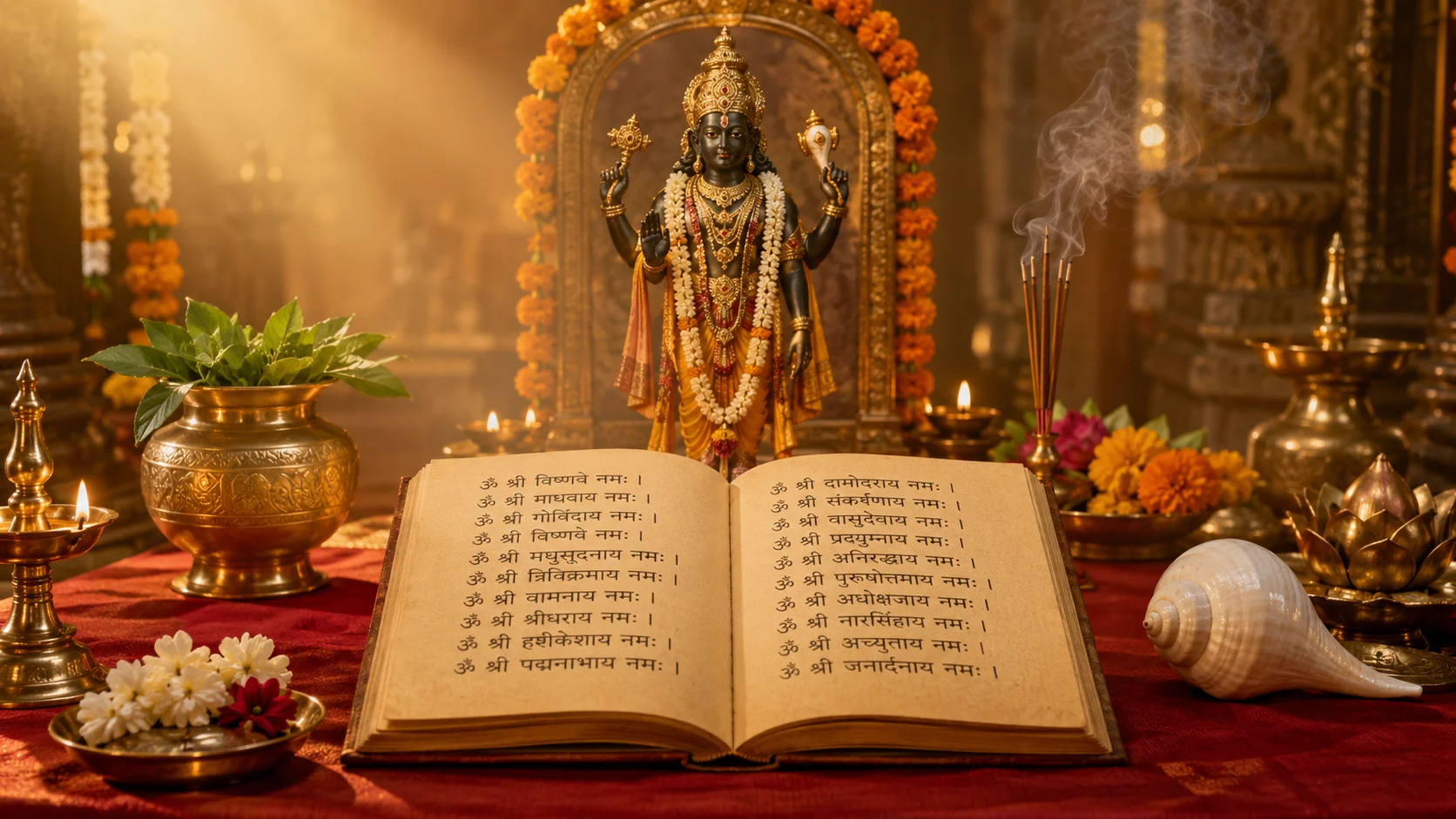
The Vishnu Sahasranama was spoken by Bhishma as he lay dying on a bed of arrows, with Krishna himself listening — a thousand names for one God, given as the last teaching of a warrior who had waited his whole life to give it. Here is what it contains and how it is recited.
What is the Vishnu Sahasranama?
The Vishnu Sahasranama is a hymn of one thousand names of Lord Vishnu. Each name is not merely a label but a description — a quality, an act, or an aspect of the divine. Together they attempt something the tradition considers impossible and attempts anyway: to describe the indescribable by circling it a thousand times. Names such as Narayana, Vasudeva, Hari, Govinda, Madhava, Ananta and Achyuta appear within it, and many are recited independently as complete prayers in their own right.
Where does it come from?
It appears in the Anushasana Parva, the thirteenth book of the Mahabharata. After the war has ended, Bhishma lies on his bed of arrows, waiting for the auspicious hour of his death. Yudhishthira comes to him with questions, and asks which hymn a person should recite to be freed from all sorrow. Bhishma answers with the thousand names of Vishnu, with Krishna present as he speaks. The setting matters to devotees: this is not a text composed in comfort, but the final teaching of a dying man who chose these words above all others he could have left behind.
How is the stotra structured?
Dhyanam: The opening meditation verses, which settle the mind and place the image of Vishnu before it — reclining on Ananta, ocean-coloured, lotus-eyed.
The thousand names: The body of the text, arranged in shlokas, beginning with Vishvam Vishnur Vashatkaro — "the universe, the all-pervading one, the one to whom oblations are offered." The names are not in any alphabetical or hierarchical order; they unfold as praise rather than as a list.
Phala shruti: The closing section, which describes what the tradition holds recitation brings — freedom from fear, from illness, from sorrow, and steadiness of mind.
The most influential commentary on the text was written by Adi Shankaracharya, who read each of the thousand names through the lens of Advaita Vedanta. His bhashya is the reason the Sahasranama occupies the place it does in both devotional and philosophical study.
How should it be recited?
Begin by bathing and sitting facing east or north before a clean altar. Light a lamp. If you keep a murti or image of Vishnu — or of Laxmi Narayan — place it before you, and offer tulsi leaves if you have them, as tulsi is inseparable from Vishnu worship.
Recite the dhyanam first, then the names, then the phala shruti. Do not rush. The tradition is emphatic that a slower recitation with understanding is worth more than a fast one without it — and for a text of a thousand names, that patience is the practice itself. Many devotees count recitations on a tulsi japa mala, which is the mala traditionally used for Vishnu mantras.
If the full text is too long to begin with, it is entirely acceptable to start by listening to it while following the words, and to take up recitation once the sound is familiar. Nothing in the tradition demands that a beginner start at full length.
When is the best time to recite it?
Ekadashi is considered the most auspicious day, being sacred to Vishnu. Saturdays are also traditionally favoured, as are Vaikuntha Ekadashi and the month of Kartik. Beyond these, the Sahasranama is recited daily in countless homes — early morning, after bathing, before the day begins.
What benefits does the tradition describe?
The phala shruti speaks of release from fear and grief, protection from illness, clarity of mind, and steadiness in difficulty. Devotees describe the more immediate effect as a settling — a thousand names take time to say, and the saying of them slows a restless mind whether or not one arrives expecting it.
Approached honestly, the Sahasranama is less a request than a remembering. Bhishma did not offer Yudhishthira a way to get something. He offered him a way to hold the divine in mind, one name at a time, until the mind stopped struggling.