Vat Purnima Vrat: The Story of Savitri Who Outwitted Death
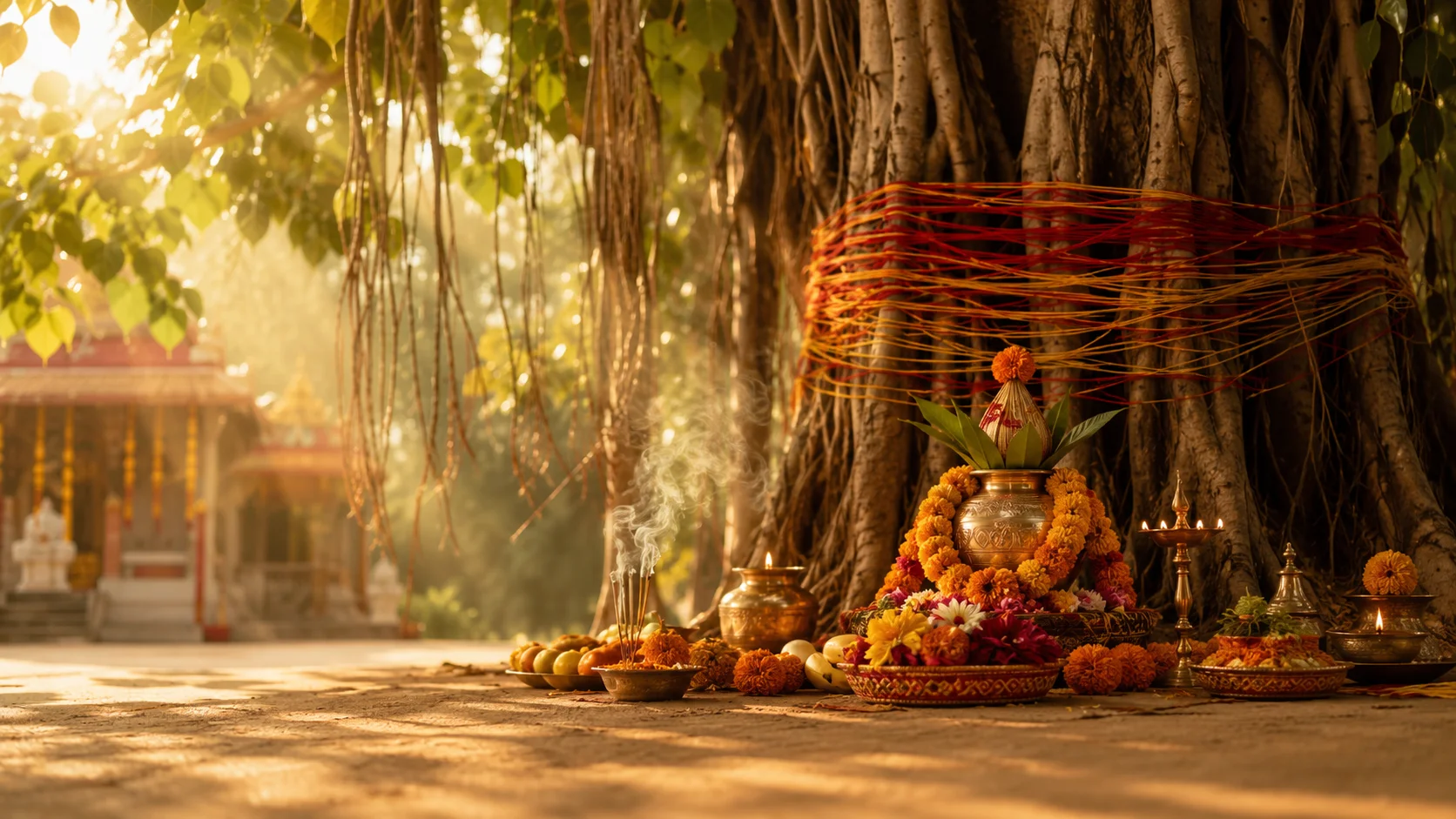
A wife follows the god of death into the forest and argues her husband back to life. That story is the heart of Vat Purnima — one of the most emotionally resonant vrats in the Hindu calendar.
What is Vat Purnima Vrat?
Vat Purnima — also called Vat Savitri Vrat in many regions — is observed by married women on the full moon (Purnima) day of the Hindu month of Jyeshtha, typically falling in May or June. The name comes from the Vat or banyan tree, under whose shade the entire ritual takes place. Women fast through the day, gather at a banyan tree, tie a sacred thread around its trunk, and circumambulate it repeatedly while praying for the long life, health, and prosperity of their husbands. The festival is observed with particular devotion in Maharashtra, Gujarat, Uttar Pradesh, and Bihar, and a closely related observance — Vat Savitri Vrat, on the new moon of the same month — is followed in several northern states. The ritual differs by region in small details, but the story and the spirit are identical everywhere: a wife's devotion strong enough to negotiate with death itself.
What is the story of Savitri and Satyavan?
The tale comes from the Mahabharata and the Brahma Vaivarta Purana. Savitri was the daughter of King Ashwapati, born after eighteen years of penance and prayer for a child. As a young woman of extraordinary will, she chose her own husband — Satyavan, a prince living in exile in the forest, noble in character but without a kingdom. Sage Narada, who had foreseen Satyavan's fate, warned Savitri before the marriage: Satyavan was destined to die within exactly one year. Savitri married him anyway, fully informed, and devoted herself completely to their life together. On the foretold day, Satyavan collapsed while cutting wood beneath a banyan tree. Yama, the god of death, appeared in person to take his soul — an extraordinary detail in itself, since Yama rarely comes for an ordinary mortal. Savitri followed him on foot as he carried Satyavan's soul away, refusing to turn back despite Yama's repeated insistence that she could not accompany him further. Impressed by her resolve, Yama granted her a series of boons — careful, at first, not to include Satyavan's life directly. Savitri, with remarkable presence of mind, asked for sons through Satyavan as her final boon. Yama granted it without realizing the trap: sons through Satyavan were impossible unless Satyavan lived. Bound by his own word, Yama was forced to restore Satyavan's life. Savitri's intelligence, not just her devotion, is what the story ultimately celebrates.
Why is the banyan tree central to this vrat?
The Vat tree holds a layered symbolism in Hindu thought that goes beyond its role in the Savitri story. Its roots are associated with Brahma, its trunk with Vishnu, and its upper branches with Shiva — making the tree itself a living representation of the full trinity. Its long lifespan and its unusual capacity to send new roots down from its branches make it a natural symbol of permanence and renewal, which is precisely what the vrat asks for: a marriage that endures. Where a banyan tree is not accessible, women perform the same ritual before a branch, a painted image, or a printed picture of the tree placed on the home altar — the symbolic presence of the tree is considered sufficient when the real tree is out of reach.
How is Vat Purnima Vrat performed?
Women rise before sunrise, bathe, and dress as a bride would — new clothes, bangles, and sindoor, regardless of how many years they have been married. A bamboo basket is prepared with seven types of grain, fruit, flowers, kumkum, raw cotton thread, and a small lamp. At the banyan tree, idols or images of Savitri, Satyavan, and Yama are installed, and worship begins with offerings of water, rice, and flowers to the tree itself. Vermilion is sprinkled around the trunk, a sacred thread is wound around it, and women circumambulate the tree — traditionally up to 108 times — while reciting prayers for their husband's health and longevity. The Vat Purnima Vrat Katha — the story of Savitri — is read or listened to as part of the ritual. The fast, observed without food and in many traditions without water as well, is broken only after the rituals are complete, with prasad that typically includes soaked grains, mango, jackfruit, banana, and lemon.
What does Savitri's story actually teach?
It would be easy to read the Savitri legend as simply a story about a devoted wife, but the text itself emphasises something sharper: intelligence used in service of love. Savitri does not beg, threaten, or attempt to physically stop Yama — all approaches that would have failed against the god of death. Instead, she matches his own rules. Every boon she requests in the early part of the exchange appears modest and unconnected to Satyavan's fate, disarming Yama's caution, until her final request closes the trap he did not see forming. This is why the Vat Purnima Vrat is remembered not only as an act of faith but as a demonstration that devotion and sharp thinking are not opposites — that real love, in this telling, includes the discipline to outthink the very forces working against it.
Shop brass murtis, deepaks and pooja essentials at HanumanSetu.com →