Puri Rath Yatra: The History and Meaning of the Chariot Festival
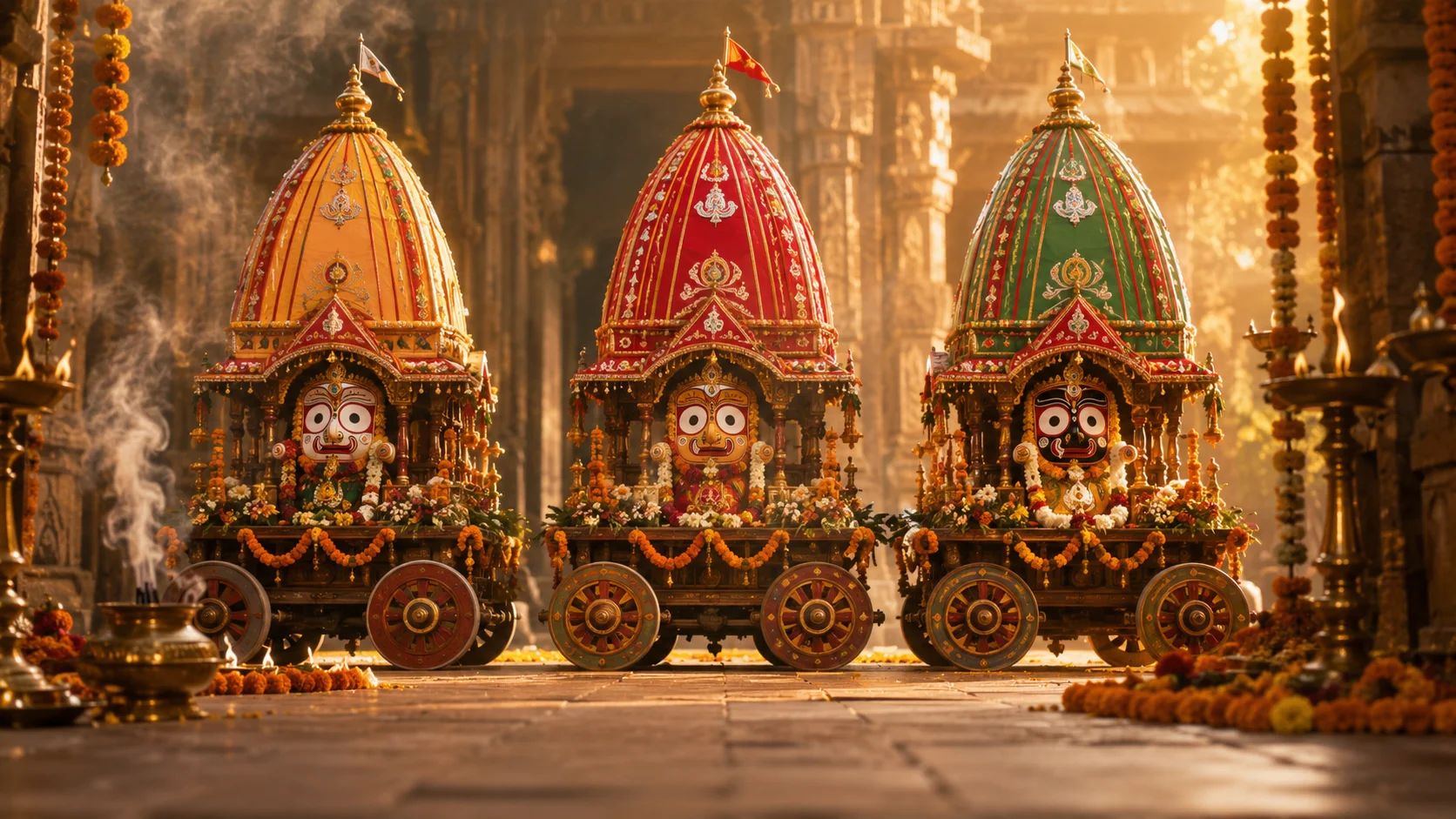
Three wooden chariots, built fresh every year without a single nail, carried by the hands of a million pilgrims. The Puri Rath Yatra is one of the oldest continuously observed festivals on earth — here is its full story.
What is the Puri Rath Yatra?
The Rath Yatra, or Chariot Festival, is the annual journey of Lord Jagannath, his elder brother Lord Balabhadra, and his sister Devi Subhadra from the great Jagannath Temple in Puri, Odisha, to the Gundicha Temple roughly three kilometres away. The deities travel in three towering wooden chariots, hand-pulled by thousands of devotees along Puri's Grand Road, in a procession that regularly draws crowds exceeding half a million people in a single day. The festival falls on Dwitiya Tithi of Shukla Paksha in the Hindu month of Ashadha — typically June or July — and the deities remain at the Gundicha Temple for nine days before returning to the main temple in a mirror procession called Bahuda Yatra. Lord Jagannath is worshipped as a form of Lord Vishnu, and the Rath Yatra is considered, according to the Skanda Purana, the single most significant of the twelve annual festivals associated with him.
What is the story behind the journey?
The most commonly told legend holds that Devi Subhadra expressed a wish to visit her maternal aunt's home in Gundicha. Her brothers, Jagannath and Balabhadra, decided to accompany her, and what began as a simple family visit became the template for an annual pilgrimage repeated for centuries. A second, related legend ties the journey to Mathura — the birthplace of Lord Krishna, whom Jagannath is understood to embody — framing the yatra as the Lord's yearly visit to the place of his origin. Both versions point to the same essential idea: the deity is not confined within the temple's sanctum. Once a year, he steps outside, onto the open road, where every devotee — regardless of caste, position, or whether they would ordinarily be permitted inside the temple itself — can stand before him directly.
Why are the chariots rebuilt every single year?
Tradition requires that all three chariots be constructed completely anew each year, using specific timber — primarily phassi and dhausa wood — sourced from the Dasapalla forests of Odisha by hereditary carpenters whose families have held this exclusive right for generations. Construction begins on Akshaya Tritiya, months ahead of the festival. None of the previous year's wood is reused, and no chariot is held over for a future year. Lord Jagannath's chariot, Nandighosha, stands around 45 feet tall on sixteen wheels, wrapped in red and yellow cloth. Lord Balabhadra's chariot, Taladhwaja, runs on fourteen wheels in red and green. Devi Subhadra's chariot, Darpadalana, has twelve wheels in red and black. Each is assembled without a single nail, following construction specifications passed down for generations through the hereditary servitor communities of Puri — the Daitas, Suaras, and other designated groups whose work has continued, unbroken, for over a thousand years.
What happens during the nine days of the festival?
The procession begins with Pahandi — a rhythmic, ceremonial movement of the deities from the temple sanctum to their chariots, performed by the servitors with deliberate, swaying steps believed to carry the deity's own dance-like grace. Before the chariots move, the King of Puri — the Gajapati — performs Chhera Pahara, sweeping the chariot platforms with a golden broom. This single ritual carries enormous symbolic weight: it is the king himself, the most powerful man in the kingdom, taking on the role of a humble sweeper before the Lord, a public statement that before Jagannath, all status dissolves. The chariots are then pulled by thousands of devotees along the Grand Road to Gundicha Temple, where the deities remain for nine days. The return journey, Bahuda Yatra, follows the same route in reverse, and the deities are dressed in a special golden attire called Suna Vesa before returning to the sanctum.
Why does this festival matter beyond Odisha?
Rath Yatra is celebrated well beyond Puri — in Ahmedabad, Kolkata, Vrindavan, and through ISKCON communities in cities across the world, from London to New York to Sydney. Its core message travels with it: the divine moving toward the devotee rather than waiting to be approached. The Puri procession is open to all, regardless of religion or nationality, even though entry to the temple sanctum itself remains restricted. That openness — a major festival of one of Hinduism's most ancient living temple traditions, witnessed and participated in by people of every background — is itself part of why the Rath Yatra has endured, structurally unchanged, for over a thousand years.
Shop brass murtis, deepaks and pooja essentials at HanumanSetu.com →