Jagannath Rath Yatra: Full Story, Origin Legends & Spiritual Significance
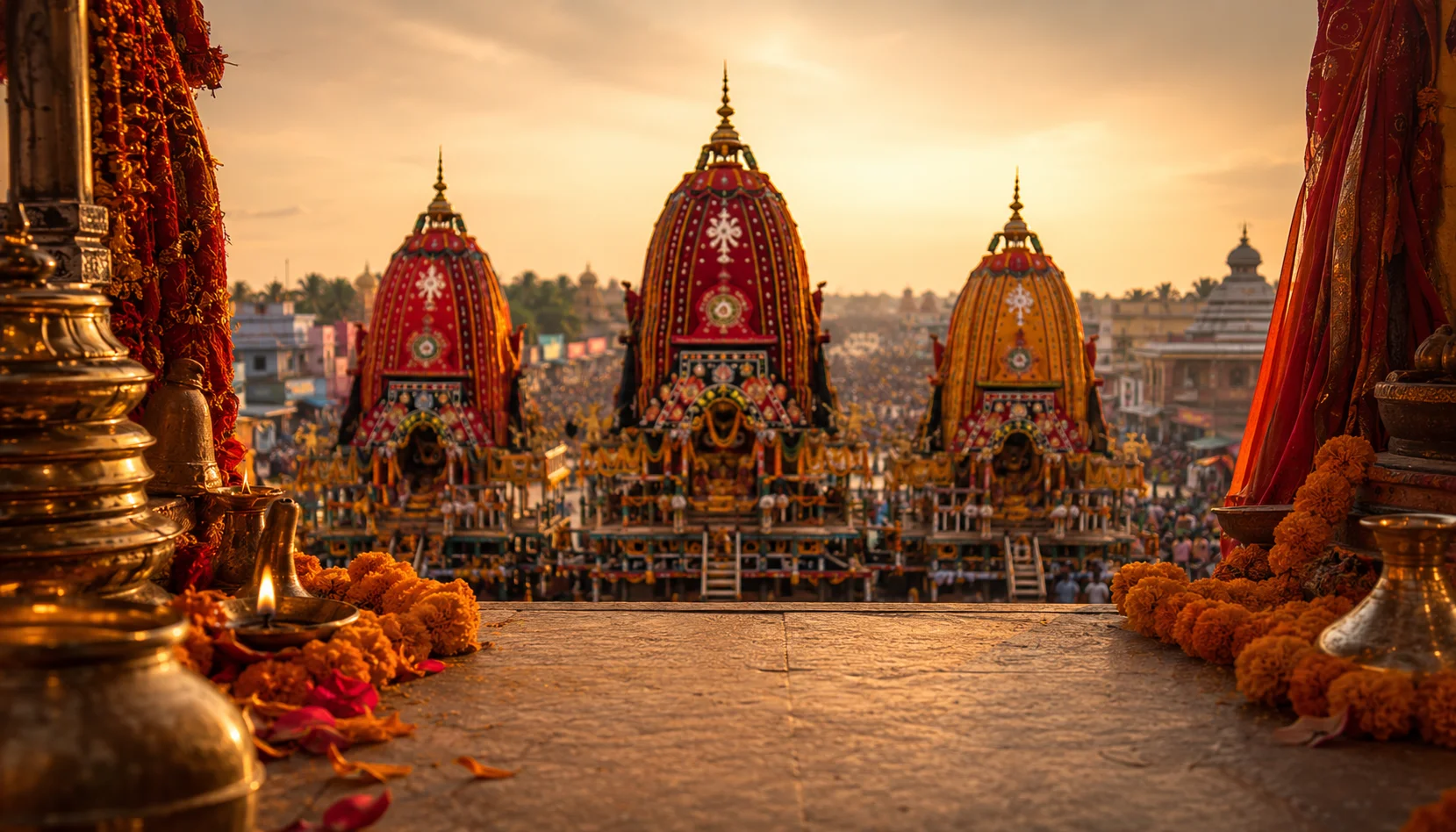
"Jai Jagannath! Once a year, the Lord of the Universe steps out of His grand sanctum to meet His devotees on the sacred streets of Puri..."
Have you ever wondered why Lord Jagannath, along with His elder brother Lord Balabhadra and beloved sister Devi Subhadra, leaves the iconic Puri Temple to ride monumental wooden chariots?
The **Jagannath Rath Yatra** in Puri, Odisha, is not merely a grand festival; it is a profound manifestation of divine compassion. In every other temple, devotees travel miles to gaze upon the deity enshrined within the inner sanctum. But during Rath Yatra, the Lord Himself steps outside—opening His arms to every soul regardless of caste, creed, background, or past mistakes. Let us immerse ourselves in the timeless legends, origins, and spiritual story of this sacred journey.
1. The Sacred Legend of King Indradyumna & Nila Madhava
The story of Lord Jagannath’s appearance begins in ancient times with **King Indradyumna** of Avanti, a devout king who yearned to behold the Supreme Lord in His most merciful form. In a vision, he was told of a mysterious, luminous deity named **Nila Madhava** worshipped in secret within the deep forests of Odisha by a tribal chief named **Vishwavasu**.
The king dispatched his trusted priest, **Vidyapati**, to locate the deity. Guided by patience and love, Vidyapati reached the forest dwelling and gained the trust of Vishwavasu. When Vidyapati finally beheld Nila Madhava in a hidden cave, he was overwhelmed with ecstatic tears. However, when King Indradyumna personally arrived to build a temple for the Lord, Nila Madhava vanished into the earth, leaving behind only golden sands.
Devastated, the king performed intense austerities on the shores of Puri. Pleased with his devotion, a divine voice echoed from the heavens: "Do not despair, O King. I shall float upon the ocean as a sacred Daru (fragrant Neem wood log). From that wood, carve my divine forms."
2. The Unfinished Idols: The Divine Condition of Vishwakarma
Soon, an extraordinary log of blue Neem timber drifted to the Puri shore, glowing with celestial radiance. The king assembled master artisans, but no iron chisel could mark the sacred wood—every tool shattered upon contact.
At last, the divine architect **Vishwakarma** appeared disguised as an elderly, frail carpenter named Ananta Maharana. He agreed to carve the idols on one strict condition: He must work entirely alone inside the sealed temple doors for 21 days, and no one must interrupt or open the doors until the time is complete.
Fifteen days passed. Outside the temple, **Queen Gundicha** became anxious because the sound of carving tools had completely stopped. Fearing for the old artisan's life, she persuaded King Indradyumna to open the heavy doors prematurely.
As the doors opened, the old carpenter vanished into thin air. Before the king stood three half-finished wooden idols—with large, round, expressive eyes, flat heads, and extended stumps for arms, lacking distinct hands and feet.
As King Indradyumna wept over his mistake, **Lord Brahma** appeared and revealed the deeper truth: "This is not incomplete. The Supreme Personality of Godhead has chosen this form out of His supreme love for His devotees. In this form, with large eyes watching over the cosmos and open arms to embrace all, He shall reside as Lord Jagannath!"
3. Why the Three Siblings Ride the Chariots (The Vrindavan Vraj-Katha)
Another enchanting legend explains why Lord Jagannath travels with His elder brother **Lord Balabhadra** and younger sister **Devi Subhadra** during Rath Yatra.
In Dwarka, Lord Krishna's queens requested **Mother Rohini** to narrate Shri Krishna's childhood Vrindavan pastimes (Rasa Leela). Knowing the intense emotional impact of these stories, Rohini placed Subhadra at the door to ensure Krishna and Balarama did not hear. However, as Rohini described the boundless love of the Gopis and residents of Vrindavan, Subhadra became completely entranced.
Krishna and Balarama arrived at the door, and as they listened to the Vrindavan pastimes, all three siblings entered a state of overwhelming divine ecstasy (*Maha-Bhava*). Their eyes widened in wonder, their limbs retracted in intense emotional bliss, and their forms transformed into the very shapes we worship today at Puri.
Watching this divine sight, the celestial sage **Narada** prayed that the Lord would reveal this compassionate form to all mankind. Fulfilling this boon, Lord Jagannath travels every year to His aunt's home—the **Gundicha Temple**—commemorating Shri Krishna’s return journey to Vrindavan.
4. Key Rituals of the Grand Puri Rath Yatra
The Jagannath Rath Yatra involves centuries-old sacred rituals that showcase extreme devotion and humility:
- Snana Yatra & Anasara: Before the Rath Yatra, on Devasnana Purnima, the deities are bathed with 108 pots of herbal water. It is believed the deities fall ill after the bath and are kept in isolation (*Anasara*) for 15 days, treated with natural herbs by royal physicians before emerging refreshed.
- Pahandi Bije: The ceremonial, rhythmic procession where the heavy wooden deities are lovingly brought out from the inner sanctum to their magnificent chariots—*Nandighosha* (Jagannath), *Taladhwaja* (Balabhadra), and *Dapadalana* (Subhadra).
- Chhera Pahanra: In a supreme display of humility, the Gajapati King of Puri sweeps the floor of the chariots using a broom with a golden handle, proving that before Lord Jagannath, a king and a commoner are equal servants.
- Return Journey (Bahuda Yatra): After residing at the Gundicha Temple for 9 days, the deities journey back to the main Puri Temple, followed by the spectacular *Suna Besha* where they are adorned in massive gold ornaments.
5. The Unbreakable Faith of Bhakta Salabega
The divine merciful nature of Lord Jagannath is immortalized in the story of **Salabega**, a Muslim devotee and poet who loved the Lord with single-minded devotion. Denied entry into the main temple due to social rules, Salabega prayed fervently as he traveled toward Puri during Rath Yatra.
Realizing he would not reach Puri in time, Salabega cried out: "Wait, O Lord of the Universe! Do not move until your servant arrives!" Miraculously, Lord Jagannath's giant chariot, Nandighosha, came to a sudden halt on the Grand Road (*Bada Danda*). Thousands pulled with ropes, and royal elephants pushed, but the chariot did not move a single inch until Salabega arrived and fell at the Lord's wheels. To this day, the chariots pause briefly near the Samadhi of Salabega as a tribute to pure love.
6. Bringing the Divine Grace of Lord Jagannath Home
Worshipping Lord Jagannath at home invites joy, eliminates fear, and brings protective family harmony. Whether enshrining a handcrafted Neem-wood Jagannath Trinity set on your altar or wearing a consecrated Rudraksha mala to deepen your daily meditation, pure devotional intention is all that the Lord asks for.
"Jagannatha Swami Nayana Patha Gami Bhavatu Me!"
May Lord Jagannath, the merciful Lord of the Universe, forever guide your eyes, protect your home, and bless your spiritual path.