Hariyali Teej: The Story of Parvati's 108 Lifetimes of Devotion
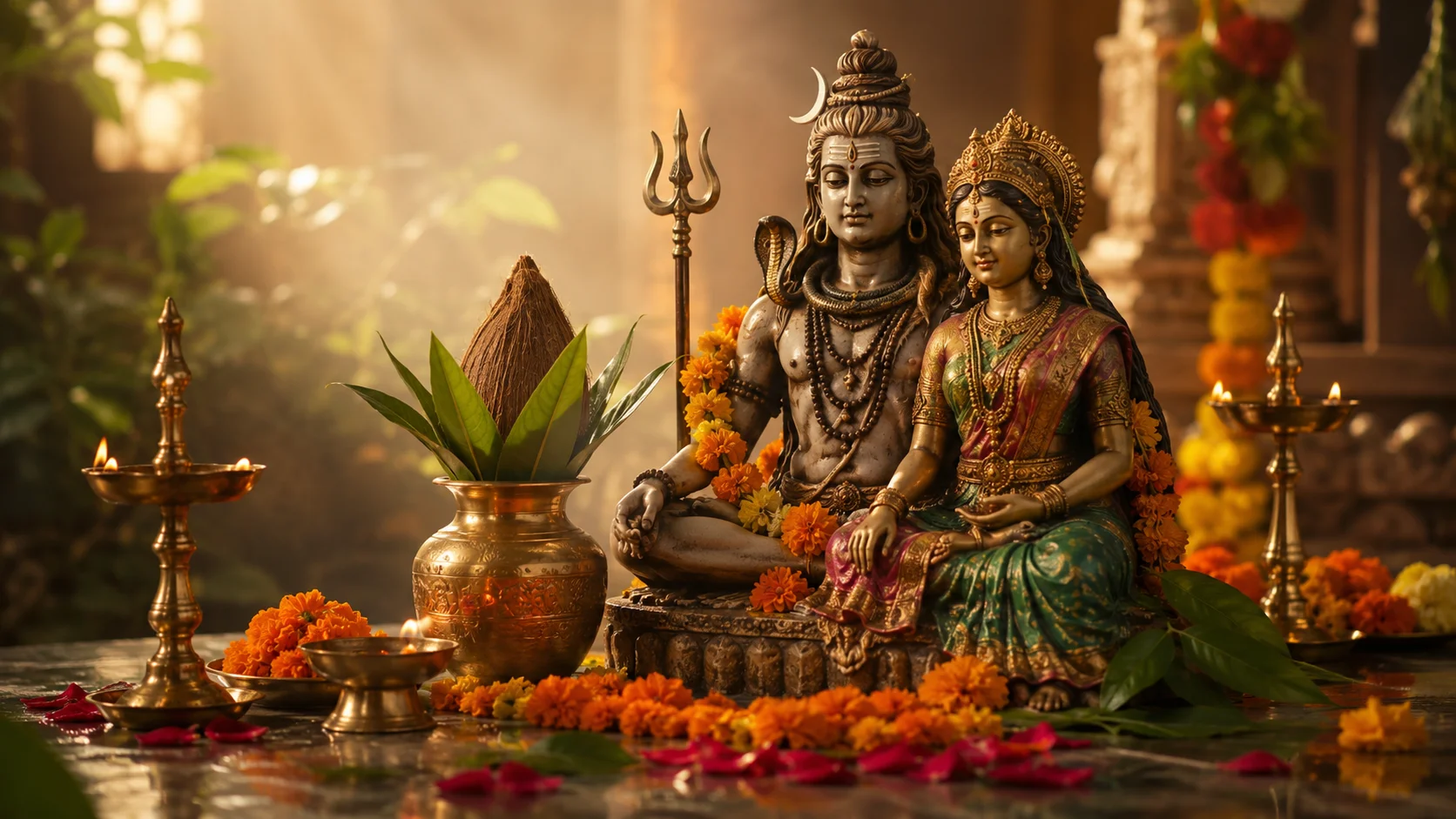
One hundred and eight lifetimes of penance for a single marriage. Hariyali Teej celebrates the most patient love story in Hindu tradition — and arrives each year with the first green of the monsoon.
What is Hariyali Teej?
Hariyali Teej falls on the third day (Tritiya) of the waxing moon fortnight in the Hindu month of Shravan, landing in late July or August on the Gregorian calendar — right in the heart of the monsoon season. The name itself describes the moment: hariyali means greenery, the lush cover that spreads across North India once the rains arrive, and Teej refers to the third lunar day. The festival celebrates the union of Lord Shiva and Goddess Parvati, and is observed primarily by married women, who fast and pray for their husband's health and long life, and by unmarried women, who pray to Parvati for a husband of equal devotion and character. It holds particular prominence in Rajasthan, Uttar Pradesh, Bihar, and Haryana, with regional names that include Teeyan in Punjab and Shingara Teej in parts of Rajasthan.
What is the story of Parvati's devotion?
According to the Shiva Purana, Goddess Parvati's path to marrying Lord Shiva was not the work of a single lifetime. Her first incarnation was as Sati, Shiva's first wife, whose story ended in tragedy and left Shiva in deep, prolonged grief, withdrawn entirely from worldly attachment. The tradition holds that Sati's soul was reborn again and again — 107 separate lifetimes in total — and in each one, she pursued the same unwavering goal through intense penance and discipline. It was only in her 108th birth, as the daughter of Himavan, King of the Mountains, that her tapasya finally reached Shiva. She left the comfort of her father's palace and went into the Himalayas, living an ascetic's life of prayer and austerity to prove a devotion that words alone could not. Moved at last by the depth and persistence of her penance, Shiva accepted her as his wife. The marriage is understood to have taken place on the third day of Shravan Shukla Paksha — the very day Hariyali Teej now commemorates. Because of this, Goddess Parvati is affectionately known on this day as Teej Mata.
Why does the festival centre on patience and persistence?
Where many Hindu festivals commemorate a single decisive event — a victory, a birth, a rescue — Hariyali Teej commemorates the opposite: a hundred and eight lifetimes of refusing to give up. That is precisely what gives the festival its emotional weight for the women who observe it. The vrat is not understood as a request for instant favour, but as a small act of the same patient, sustained devotion that ultimately moved even Shiva. Married women observing the fast are not simply asking for their husband's wellbeing in the moment; they are participating in a tradition that holds endurance itself — in marriage, in faith, in any relationship worth keeping — as the thing being honoured.
What are the key rituals of Hariyali Teej?
The day before the festival, in-laws traditionally send Sinjara to daughters-in-law — a gift of henna, sweets, and jewellery that signals affection and welcome into the family. On the day itself, women bathe, dress in green — the colour of the monsoon and of marital auspiciousness — and apply mehendi to their hands and feet, with the depth of colour popularly said to reflect the strength of a husband's love. A small altar is prepared, often shaped from sand or clay into images of Shiva, Parvati, and Ganesha, and a full Shodashopchar Puja — sixteen distinct steps of worship — is performed, with offerings of flowers, bel patra, and incense. Many women observe a complete fast, some choosing the rigorous Nirjala form without water, lasting through the day until the moon is sighted and worshipped that evening. Swings tied to banyan or other large trees are a defining image of the festival, with women gathering to swing, sing traditional Teej folk songs, and spend the day in the company of other women — a rare day given over entirely to communal joy. Three mental pledges are also traditionally part of the vrat's spirit: to avoid deceit, to refrain from harsh speech, and to avoid causing distress to others.
Can unmarried women observe Hariyali Teej?
Yes. While the festival's most visible association is with married women praying for their husband's wellbeing, unmarried women observe the same fast and the same rituals with a different intention — praying to Goddess Parvati for a life partner who carries the same depth of character and devotion that Shiva eventually recognised in her. The inclusion of unmarried women in the observance is itself an extension of the central story: Parvati's penance began long before she had any certainty that Shiva would accept her, and the festival honours that same hopeful, sustained devotion in women still waiting for their own version of that union. In this sense, Hariyali Teej is less a celebration reserved for the already-married than an invitation extended to anyone willing to hold faith through uncertainty.
Shop brass murtis, deepaks and pooja essentials at HanumanSetu.com →