Guru Purnima: Why Hindus, Buddhists and Jains All Observe It
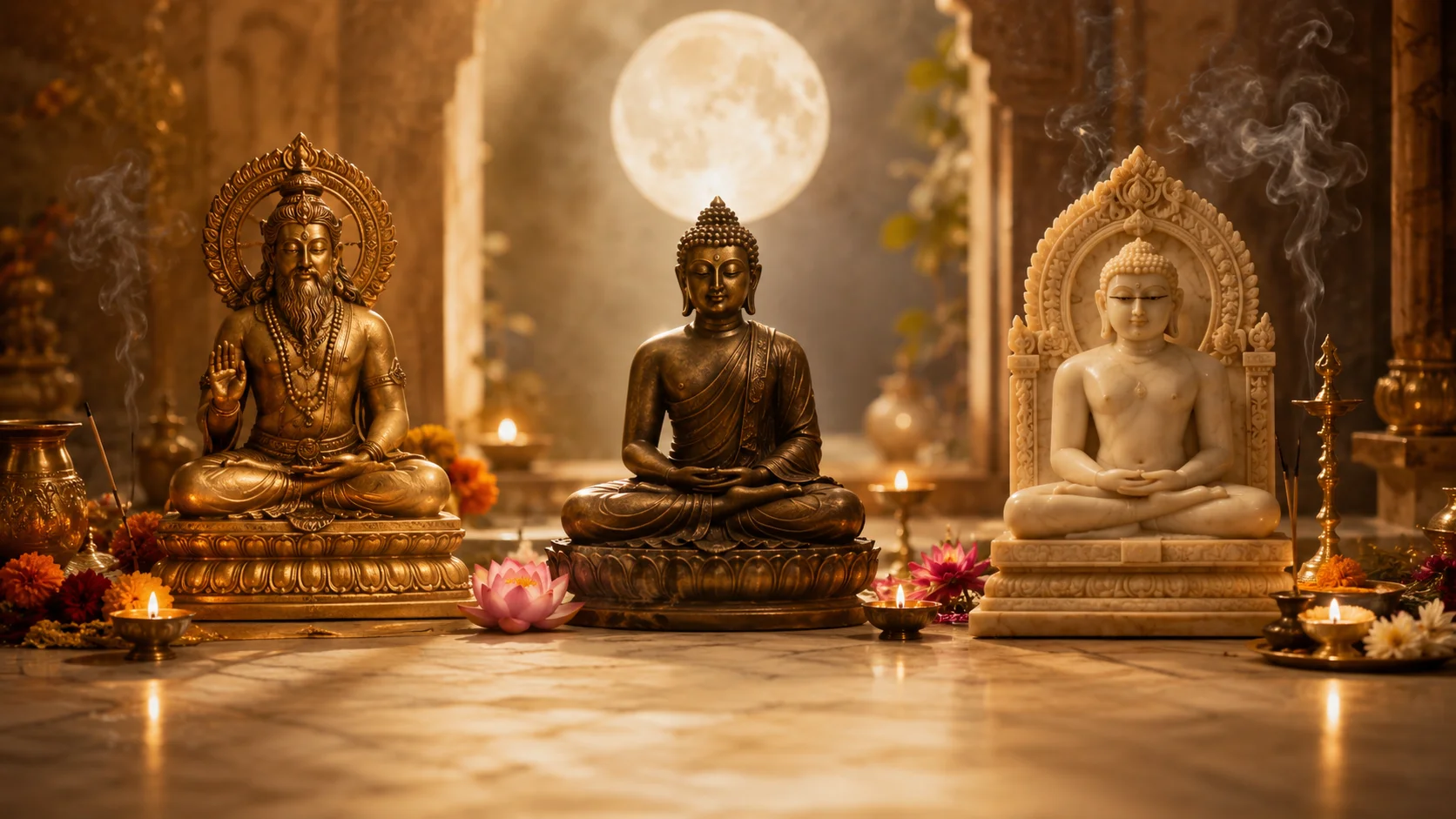
One full moon day. Three entirely different religious traditions. Guru Purnima is the rare festival that belongs equally to Hindus, Buddhists, and Jains — here is why.
What is Guru Purnima?
Guru Purnima falls on the full moon day of the Hindu month of Ashadha, typically in July, and is dedicated entirely to honouring teachers — spiritual, academic, and personal. The word Guru breaks down into two Sanskrit roots: gu, meaning darkness or ignorance, and ru, meaning the one who removes it. A guru, by this definition, is not simply someone who instructs — it is someone whose guidance dissolves ignorance and replaces it with clarity. In Hindu tradition, the day is also called Vyasa Purnima, commemorating the birth of Sage Ved Vyasa, who is regarded as the Adi Guru — the first and foremost teacher in the entire Sanatan tradition.
Why is Guru Purnima also called Vyasa Purnima?
Ved Vyasa is one of the most consequential figures in Hindu scripture, credited with an almost unimaginable body of work: he organised the single, vast body of Vedic knowledge into the four Vedas — Rigveda, Yajurveda, Samaveda, and Atharvaveda — making it possible for the knowledge to be preserved, taught, and transmitted across generations rather than lost to time. He is also credited as the author of the Mahabharata, which contains the Bhagavad Gita, and as the compiler of the eighteen Puranas. According to tradition, Vyasa was born on this very full moon day, and Guru Purnima marks both his birth and his unparalleled contribution as a teacher. Disciples across the Hindu world perform Vyasa Puja on this day specifically in his honour, regarding him as the source from which the entire Guru-Shishya tradition flows.
Why do Buddhists and Jains observe the same day?
For Buddhists, Guru Purnima marks the anniversary of Gautama Buddha's first sermon, delivered at Sarnath shortly after he attained enlightenment. In that sermon — known as the Dharmachakra Pravartana Sutra, or the turning of the wheel of dharma — Buddha introduced the Four Noble Truths and the Eightfold Path to his first five disciples, an event that formed the foundation of the Sangha, the monastic community that has carried his teaching forward ever since. For Jains, the day commemorates Lord Mahavira's acceptance of his first disciple, Gautama Swami, the moment that formally established the teacher-student relationship within the Jain tradition. Three entirely distinct paths, one shared recognition: that wisdom is not self-generated, and that every meaningful spiritual journey begins with someone willing to teach and someone willing to learn.
What is the significance of the Guru-Shishya relationship?
The bond between teacher and student — Guru-Shishya Parampara — sits at the structural centre of Indian spiritual and intellectual tradition. For thousands of years, knowledge in fields ranging from the Vedas to classical music to martial arts has been transmitted not primarily through written texts but through this direct, lived relationship, passed unbroken from one generation to the next. Guru Purnima honours that lineage in its entirety — not only one's own personal guru, but the long chain of teachers reaching back through history, all the way to figures like Vyasa himself. A well-known Hindi couplet attributed to the poet-saint Kabir captures the weight given to this relationship: if the Guru and God stood before you together, the verse holds, one should bow to the Guru first — because it is the Guru who makes it possible to recognise God at all.
How is Guru Purnima observed?
Disciples traditionally begin the day with a bath before sunrise and wear clean clothes, often yellow, the colour associated with Jupiter (Brihaspati), the planet linked to wisdom in Vedic astrology. An altar is prepared with an image of one's personal guru alongside Ved Vyasa, offered flowers, fruit, and a lit diya. Padapuja — the ritual washing and worship of the guru's feet or sandals — is a central practice, along with the offering and acceptance of Charanamrit, water sanctified by contact with the guru's feet, taken as a gesture of humility. Many disciples spend the day in reading — particularly the Bhagavad Gita, given Vyasa's authorship — and in reciting the well-known shloka: Gurur Brahma Gurur Vishnu, Gurur Devo Maheshwarah, Guruh Sakshat Parabrahma, Tasmai Shri Gurave Namah — the Guru is Brahma, the Guru is Vishnu, the Guru is Shiva, the Guru is the Supreme itself. In modern practice, the day has also become a broader occasion to express gratitude to any teacher, mentor, or guide — academic or otherwise — whose influence has shaped one's path.
Shop brass murtis, deepaks and pooja essentials at HanumanSetu.com →